The Demo Is Not a Smaller Finished Record
A demo should communicate the song’s central idea, not imitate a polished record. Learn what to capture, what to leave rough, and what to share.
What does a demo need to communicate if it is not meant to sound like the finished record? A useful demo makes the song’s central idea audible: its motion, character, and the choices that still need discussion. It can be rough in ways that clarify rather than conceal those things.
In a local music scene, that distinction matters. A file passed to a bandmate, producer, or rehearsal-room collaborator is often an invitation to develop a song, not a miniature version of an imagined release. Treating it as a smaller finished record can send time toward polish before anyone agrees on what the song wants to become.
Demo as conversation
A demo is a working message. It lets another person hear something that is hard to describe in a text: where the melody leans, how the sections connect, and what kind of energy holds the arrangement together. Its success is not measured by how closely it resembles a mastered track. It succeeds when the next musical decision becomes easier to make.
That purpose changes what belongs in the recording. A scratch vocal may be more useful than a carefully layered backing part if the group needs to judge the melody. A plain guitar and voice may be enough to settle the song’s pacing. If the intended feel depends on the drummer’s push or the bass player’s movement, though, those parts may need to be represented clearly enough for collaborators to respond.
Before recording, write one sentence about the question the demo should answer. “Does the chorus feel like a release?” is more actionable than “Does this sound good?” The sentence gives you a reason to include some material and leave other material out.
Keep the musical clues
Rough does not mean careless. Preserve the details that carry the song’s identity, even if the recording around them is simple. Those clues might include a vocal pickup that makes the verse feel conversational, a pause before the hook, a clipped chord that creates tension, or a rhythmic change between sections.
Make a short capture plan before opening your recording software:
- Record the complete song form once, so collaborators can follow its shape.
- Mark any uncertain lyric, chord, or transition in the filename or a brief note.
- Keep the tempo steady enough to support listening, unless loose timing is part of the idea.
- Use a clear count-in or spoken section cue if an entrance would otherwise be hard to locate.
- Record a second pass only when it answers a specific question, such as whether a different vocal register changes the chorus.
Say you have a new song with a quiet verse, a sudden full-band chorus, and a bridge whose length is undecided. You could record one vocal-and-guitar pass, then add a simple drum pattern only for the chorus. A note saying “bridge may lose a bar; listen for the return” tells the band where feedback is needed, while the restrained arrangement leaves room to imagine alternatives.
Choose the right roughness
Some roughness is informative; some is just a barrier. A single vocal take can reveal phrasing, but a distracting click in the wrong place may pull attention away from the lyric. Room sound can suggest intimacy, while a noisy recording may make it difficult to hear a bass note that matters. The useful question is whether each imperfection helps describe the song or obscures it.
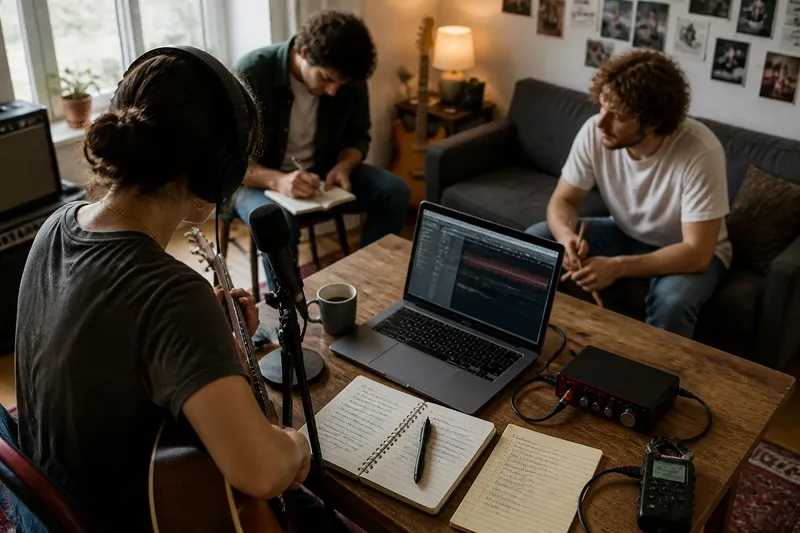
Use familiar tools rather than making the demo itself a technical project. A phone voice memo can capture a quick melody or a rehearsal idea. A laptop with a basic audio interface and a microphone can make a clearer guide vocal or instrument track. A portable recorder can preserve a band’s timing in a room. Choose the simplest setup that lets the intended listener hear the relevant musical detail.
Do not spend the afternoon chasing a perfect room tone, collecting plugins, or editing every breath if the arrangement is still unsettled. That work is not worth the effort when it does not help someone understand the song’s direction. Clean up only what interferes with the decision at hand.
Leave space for collaborators
A demo can be specific without dictating every part. If you program a complete drum track, stack several backing vocals, and fill every pause with guitar, bandmates may hear those choices as instructions even if you meant them as placeholders. When a part is undecided, say so plainly: “temporary synth line,” “open to a different groove,” or “keep the stop, but find another way to lead into it.”
At the same time, avoid leaving collaborators to guess at the basic premise. If the song depends on a lopsided rhythm, make that rhythm clear. If a repeated figure is only a guide for the bass, identify it. The goal is to distinguish what must survive from what is available for change.
Send a small amount of context with the audio: the current title, the question you want answered, and any practical note about the form. A long explanation can steer listeners toward your preferred answer before they have had a chance to hear the song. Ask for one kind of response at a time, such as comments on the chorus entrance rather than broad opinions on every sound.
What should a demo answer?
How finished should a demo sound?
It should sound clear enough for its intended listener to follow the song and hear the details under discussion. It does not need the mix, effects, or performance finish of a release if those elements are not the point of the conversation.
Should every instrument be included?
Include a part when it communicates the song’s character or helps someone respond to the arrangement. Leave a part out when it is only decorative and would make the unfinished choices harder to hear.
When is a voice memo enough?
A voice memo may be enough to preserve a melody, chord sequence, or lyric cadence for a collaborator who can imagine the rest. If timing, texture, or a specific instrumental entrance is central, capture that clue too.
How should I name a demo file?
Use a recognizable song title and a simple version note, such as “North Window – verse and chorus idea.” If the file contains a temporary part or a question, put that in the message accompanying it so the listener knows how to hear the recording.
Listen for the next choice
On playback, do not ask only whether you like the sound. Ask whether the intended listener can identify the song’s center and tell where development is needed. If the answer is no, add or clarify the missing clue. If the answer is yes, resist the urge to decorate the recording just because there is room for another track.
That is the practical meaning of a demo that is not a smaller finished record: it is shaped around a useful exchange, not a reduced version of a final mix. Keep the file easy to open, label the unresolved choice, and let the next rehearsal or conversation do work that the recording cannot do alone.
For a demo, the most valuable final edit may be a note that names what should change. The music can stay open; the listener should not have to guess what you are asking them to hear.