How Sheet Music Carried Songs Between Homes
Learn how sheet music carried songs between homes, with a clear look at notation, informal sharing, and the local choices that shaped each performance.
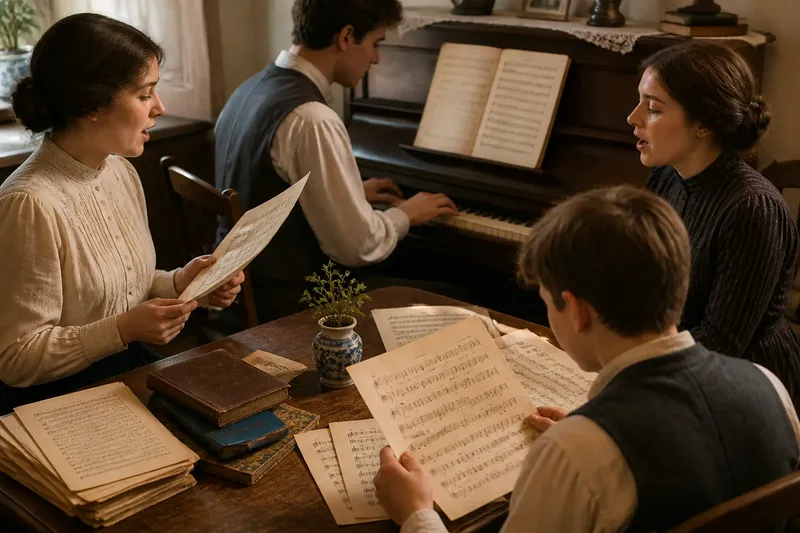
How could a song reach another household when the singer who knew it was not there? Sheet music offered one possible route: in settings where printed songs circulated, a reader could use the notation and words to help others learn a tune. The process depended on access to a copy and someone able to interpret it, not on every home having the same skills or instruments.
Find a printed song
A song sheet might be encountered through a music shop, a lending collection, a community gathering, or another household. Depending on the edition, it could include lyrics and a vocal melody, with accompaniment arranged for keyboard or another instrument. The details varied by publication and place, so a printed page was not a universal solution; it was a reference that could be useful to people who could read some notation.
Before playing, consider whether the arrangement suits the people and instruments available. A singer might follow the printed words and melody while another person handles the accompaniment. If no one can play the written part as shown, performers might use only the melody or adapt the accompaniment to an instrument they have.
Scan the page before starting. The title and lyrics identify the song, while the notes and rhythm provide a framework for the melody. The accompaniment may show where chords or bass notes support the voice. If the writing feels dense, a more confident player can take the accompaniment while someone else sings or follows the tune.
Make notation usable
Reading notation takes some familiarity with notes and rhythm. For people with that familiarity, a printed part can break a song into manageable phrases: a singer can follow the words, a player can work on the accompaniment, and performers can return to a passage without restarting from the beginning.
A page can also serve as a shared reference if a player forgets a phrase or a group is unsure where the tune turns. It does not require everyone to perform every note alike. Singers may phrase a line differently, and a household player may simplify a chord sequence to keep the song moving.
Say a household has a singer who knows the words but has not heard the tune, alongside a piano player who can read a straightforward melody. The player starts by picking out the vocal line; the singer joins once the tune feels familiar, and they add accompaniment if it suits their skills. The expected result is a shared performance, though the singer may still need practice to learn the melody.
Share copies and songs
A printed copy could be lent to a visitor, carried by a family member to another home, or brought to a gathering. Where a recipient could read the notation, the page offered a way to work out the melody and words without relying entirely on an exact oral recollection. The song might also travel through someone demonstrating it or teaching it by ear.
Sharing could be informal: someone might lend a single sheet, copy a tune into a personal collection, or pass along a volume of songs. These methods suited different circumstances. A loose page was easy to hand over; a collection kept several songs together. In places and periods where such materials circulated, print could help music cross household boundaries without the original performer being present.
As songs moved, they could become part of local social life. A tune introduced by one person might return at another gathering, where more people recognized it. Performers could associate it with a particular occasion or group. Notation supplied a reference for the musical outline; repeated performance gave the song its local meaning.
Adapt the arrangement
A printed arrangement could not account for every voice, skill level, or instrument. Home players might omit a demanding passage, sing a verse in a comfortable range, or use a simpler accompaniment. Such changes made the material workable in a particular room; they did not necessarily mean the song had stopped being shared.
Imagine a small gathering with one player who can manage the melody but not the full accompaniment. The group sings the printed words while the player carries the tune, leaving out the difficult backing. The result is a recognizable shared song, with a simpler texture suited to the people present.
It is not worth treating every printed detail as a test of musicianship. If a part keeps people from joining, simplify it or leave it out. The point is to make the song usable, not to turn an informal performance into a recital.
Questions about sheet music?
Did every home need a trained reader?
No. One reader could lead while others joined by singing, listening, or learning through repetition. People could also share the musical roles rather than expect one person to manage everything.
Could a song travel without its original singer?
Yes, when a printed page gave a new reader enough information to work out the melody and words. The receiving household still needed someone to start or teach the song, but that person did not have to be its original performer.
Did printed music make performances identical?
No. A printed arrangement supplied a common reference, while tempo, phrasing, accompaniment, and vocal range could differ. The same page could support distinct performances in different homes.
Why share a printed copy instead of teaching by ear?
Teaching by ear suited a familiar song or a setting where someone could demonstrate it. A printed copy gave readers a reference they could revisit or pass along, although it was less useful to people who could not interpret the notation.
Trace the song’s route
To understand how a song might travel between homes, follow the possible chain: someone encounters a printed tune, a reader interprets the notation, performers adapt it to their abilities, and a copy or performance reaches others. The route was not the same everywhere, and print worked alongside oral teaching and musical memory.
Sheet music could carry a shared reference, but people supplied the voice, instrument, and local memory that shaped each performance. That distinction matters: a song could cross into another household without sounding exactly as it did before, and its new arrangement might be the version that listeners there remembered.