A Listening Session Built Around One Instrument
A listening session around one instrument helps you hear entrances, pauses, and changes across three familiar tracks without losing the song.
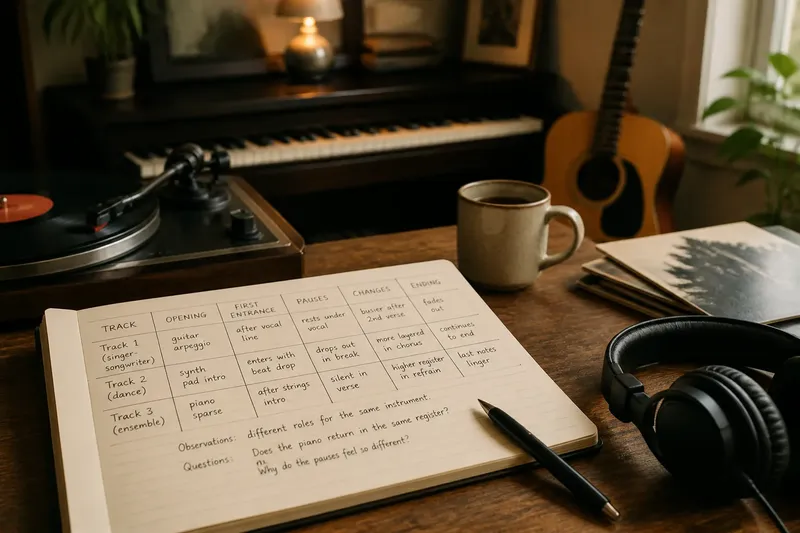
How do you follow one instrument without letting the rest of a familiar song disappear? Build a listening session around one instrument and give it a simple job: notice when it enters, when it falls silent, and how its part changes. Three tracks you already know make a useful set because recognition frees your attention for details you may have missed.
Choose an instrument that appears clearly in each track, such as piano, guitar, violin, saxophone, or drums. The songs need not come from the same genre or use the instrument in the same way. The point is to hear how one sound takes different roles in different musical settings, not to judge which arrangement uses it best.
Choose a clear thread
Start with an instrument you can identify by sound. If you are unsure, pick a track where its part is exposed: a piano phrase between vocal lines, a guitar figure near the opening, or a drum pattern you can follow through the chorus. You do not need to know the player, instrument model, or recording method. Listen for the sound’s shape and place in the arrangement.
Choose three familiar tracks with enough contrast to keep the session revealing. They might differ in tempo, vocal presence, or how crowded the arrangement feels. Avoid choosing three songs in which the instrument does exactly the same job; contrast makes entrances and changes easier to hear.
For instance, say you choose piano and already know a singer-songwriter track, a dance song, and a quiet ensemble piece. You expect to hear the piano carrying a repeated pattern in one, answering the singer in another, and appearing only in selected passages in the third. That expectation gives you something to listen for, while the tracks can still surprise you.
Make a listening map
Use a scrap of paper, a notes app, or a simple table with the track names down one side and these prompts across the top: opening, first entrance, pauses, changes, ending. The map is not a transcription. A few words such as “single notes,” “rests under vocal,” or “returns brighter” are enough to help you compare the songs afterward.
Listen to each track once without taking notes. Let the song play as a whole and notice where your attention naturally goes. On the next pass, follow only the chosen instrument. If your attention slips, wait for its next entrance rather than rewinding immediately; the gap itself is part of the arrangement.
- Entrances: Note whether the instrument starts the song, joins after another sound, or waits for a vocal or section change.
- Pauses: Notice where it drops out, even briefly, and what remains audible in its absence.
- Changes: Listen for shifts in register, rhythm, volume, density, or the length of its phrases.
- Returns: Ask whether the part comes back as before or answers something that happened while it was away.
- Ending: Notice whether the instrument stops first, sustains the last sound, or helps shape the final moment.
Write observations as they happen, not as technical judgments. “The guitar gets busier after the second verse” is more useful here than guessing a playing technique you cannot confidently name. If a detail is hard to identify, mark it with a question rather than interrupting the session to search for an answer.
Follow the part in context
Once you have a rough map for all three tracks, play selected passages again. Focus on a transition where the instrument enters or changes, then listen to the moments immediately before and after it. This reveals whether the part signals a new section, fills a space left by the voice, or simply adds motion beneath an otherwise steady passage.
Pay attention to the relationship between the instrument and the rest of the arrangement. A pause may make a vocal line feel exposed; a returning phrase may answer it. A change in the instrument’s activity can also alter the track’s sense of momentum without changing the underlying beat. These are observations about musical roles, not claims about what the musician intended.
Keep the listening map selective. You are not required to name every chord, note, or technique. A phrase like “high notes enter during the refrain” captures a meaningful change without turning the session into a theory exercise. If you already read notation or know instrument-specific vocabulary, use it where it helps; plain language remains enough to compare the tracks.
Where should you listen next?
How do I choose tracks?
Pick songs you recognize and can access without distractions, then make sure the instrument is audible in each. Contrast in arrangement is more useful than choosing tracks that share a style or mood.
What if I cannot identify the instrument?
Choose a clearer passage and compare the sound with other moments in the same track. If you still cannot name it, follow the sound by its qualities—such as sustained, percussive, high, or low—rather than guessing.
Should I use headphones?
Use whatever listening setup lets you hear the part comfortably and clearly. Headphones can help separate overlapping sounds, while speakers may make the full arrangement easier to experience; neither is necessary for the exercise.
How many times should I replay a track?
Replay only the passages that raise a useful question, such as why the instrument disappears or how it returns. Repeatedly restarting the whole track is not worth the effort if a short transition already answers what you wanted to hear.
Compare roles, not rankings
After listening, look across your notes. In one track, the instrument may establish the texture from the start; in another, it may act as a brief response; in the third, it may stay quiet until the ending. Those differences show how arrangement gives the same instrument distinct work from song to song.
Try to describe each track with one concise observation and one question. “The violin appears only between vocal phrases” is an observation; “does it return in the same register at the ending?” is a question you can check on another pass. This keeps the session open-ended without requiring a verdict about which part is most impressive.
A listening session around one instrument works best as a small change in attention, not a test of musical knowledge. Choose three familiar tracks, follow the entrances and absences, and let the instrument’s changing role come into focus. The next time you hear one of those songs casually, you may notice the instrument’s return before the melody calls your attention back.